Introduction to Synthetic Media Generation
Synthetic media generation is changing the way digital content is created, edited and distributed. Powered by artificial intelligence, it enables computers to produce realistic text, images, audio, video and virtual characters with limited human input. What once required specialised software, equipment and production teams can now be achieved through increasingly accessible AI-powered tools.
The growth of synthetic media generation is creating new opportunities for businesses, marketers, educators and content creators. Instead of treating AI simply as an automation tool, organisations can use it as a creative partner for developing personalised campaigns, producing visual assets and experimenting with new forms of storytelling.
What Is Synthetic Media Generation?
Synthetic media generation refers to the use of artificial intelligence to create or transform digital content. AI systems analyse patterns in large datasets and use those patterns to produce new material based on instructions, examples or prompts. The resulting content can include written copy, photographs, illustrations, voices, music, animations and complete videos.
Unlike traditional content production, AI-generated media can often be produced much faster and with fewer resources. A creator can describe an idea in natural language and receive a usable starting point within moments. Human editing is still important, but the technology can significantly shorten the journey from an initial concept to finished content.
How Synthetic Media Generation Works
At the heart of synthetic media generation are machine learning models trained on large collections of data. These models learn relationships, structures and patterns that allow them to predict or construct new content. Depending on the application, different technologies may be used for language, images, sound, video or combinations of several media formats.
The process generally begins with an input, such as a written prompt, image, voice sample or set of instructions. The AI model interprets that input and generates an output according to its learned patterns. Users can then refine the result by changing the prompt, adjusting settings or manually editing the generated material.
Types of Synthetic Media Generation
AI-Generated Text
AI-generated text can support articles, product descriptions, advertising copy, scripts, emails and social media content. Businesses can use language models to produce initial drafts quickly, while writers can focus on improving accuracy, tone, originality and strategic messaging.
AI-Generated Images
AI image generation allows users to create visuals from written descriptions or modify existing images. It has applications in advertising, product presentation, social media, concept development and graphic design. This makes visual experimentation considerably faster for teams that previously depended on lengthy production processes.
AI-Generated Video
AI video technology can transform scripts, images and prompts into engaging visual content. Businesses can create demonstrations, promotional clips, educational material and social media videos without organising a traditional filming process for every project. Improvements in AI video generation are also making realistic motion and virtual presenters increasingly accessible.
AI-Generated Audio and Voice
Synthetic voices can convert written scripts into natural-sounding speech and support narration, advertising, podcasts and educational resources. AI audio tools can also help organisations create multilingual versions of content. However, responsible use is essential when realistic voices are generated or reproduced.
Digital Avatars and Virtual Characters
AI-powered avatars can act as virtual presenters, instructors or brand representatives. They can deliver information in different languages and formats while maintaining a consistent appearance and presentation style. This approach can be particularly useful for training, customer education and large-scale communications.
Key Technologies Behind Synthetic Media Generation
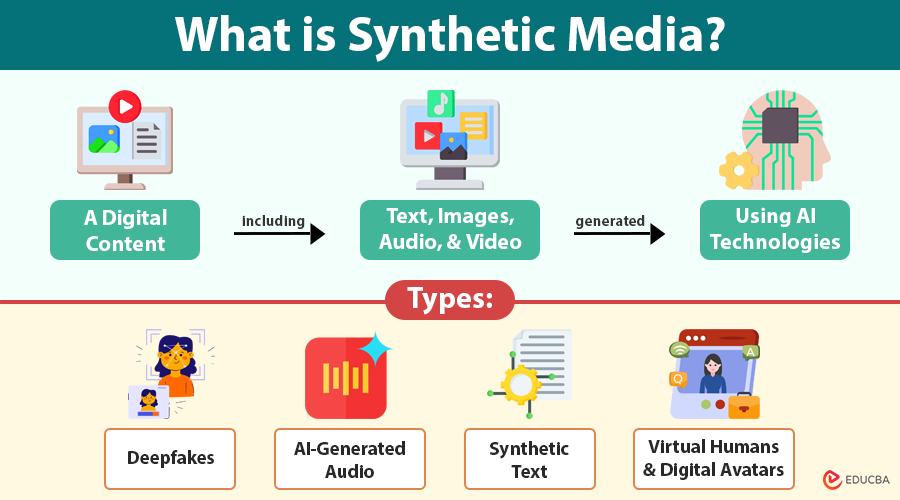
Several technologies contribute to modern AI content creation. Generative AI models can produce new material from learned patterns, while natural language processing helps systems understand and generate human language. Computer vision enables AI to analyse and create visual information, while deep learning provides the underlying architecture for many advanced media applications.
Multimodal AI is another important development because it allows systems to work across different types of information. A single workflow may combine text, images, audio and video. This makes digital production more connected and creates possibilities for interactive experiences that would have been difficult or expensive to build using traditional methods.
Benefits of Synthetic Media Generation
One of the biggest advantages of synthetic media generation is speed. A concept that might previously have taken hours or days to develop can often be transformed into an initial draft within minutes. This allows creative teams to test more ideas, respond to trends faster and produce content for multiple channels without repeating every stage of production.
The technology can also support personalisation and scalability. Businesses can adapt messaging for different audiences, languages and platforms while maintaining consistent branding. Smaller organisations may benefit particularly strongly because AI tools can provide creative capabilities without requiring large production teams, expensive equipment or extensive technical expertise.
Applications Across Industries
Synthetic media is being adopted across many industries because digital communication is now central to customer engagement. Retailers can use AI-generated product visuals, media companies can experiment with automated production, and educators can create personalised learning resources. Marketing teams can also produce multiple campaign variations for different audiences and platforms.
Entertainment and gaming represent another important area of development. AI can help generate characters, environments, dialogue and other creative assets. Corporate organisations can use virtual presenters for internal training, while customer service teams can explore AI-generated instructional videos. These applications demonstrate how synthetic content can become part of everyday digital workflows.
Synthetic Media Generation for Digital Marketing
Digital marketing is one of the areas where AI-generated media can have an immediate impact. Marketers can use AI to develop campaign concepts, write scripts, create visuals and produce short-form video content. Faster production enables teams to test different creative approaches and identify which messages generate stronger engagement.
However, successful marketing requires more than producing content quickly. Brand identity, audience expectations and authenticity still matter. Human marketers should review AI outputs carefully to ensure that claims are accurate, language is appropriate and generated content genuinely supports the campaign objective rather than simply increasing the volume of material.
Content Personalisation and Audience Engagement
AI makes it possible to create different versions of content for specific audiences. A single campaign could potentially be adapted according to language, location, interests or customer preferences. This can make digital communication feel more relevant while reducing the manual effort traditionally associated with creating multiple versions of the same campaign.
Personalisation should nevertheless be approached thoughtfully. Excessive automation can make communication feel artificial or repetitive. The strongest strategy is usually a combination of intelligent automation and human judgement, where AI handles repetitive production tasks while creative professionals determine the message, purpose and emotional direction.
Challenges and Limitations
Despite its advantages, synthetic media generation has limitations. AI systems can produce inaccurate information, visual inconsistencies, unnatural expressions or unsuitable wording. Generated content may also require several attempts before it matches the creator’s expectations. As a result, AI-generated material should not automatically be treated as finished content.
There are also practical considerations involving cost, infrastructure and workflow integration. Businesses may need suitable software, skilled employees and clear review processes. Organisations that adopt AI without appropriate oversight can create inconsistent content or introduce errors into customer-facing communications. Careful implementation is therefore essential for achieving reliable results.
Ethical Concerns and Risks
The rapid development of AI-generated media has raised important ethical questions. Realistic synthetic images, voices and videos can be misused to impersonate people or spread misleading information. Deepfakes are particularly concerning because audiences may struggle to distinguish manipulated media from genuine recordings.
Copyright, privacy and consent are also important considerations. Organisations should consider whether they have appropriate permission to use a person’s likeness, voice or creative material. Transparency can help build trust, particularly when audiences could reasonably assume that generated content is authentic. Responsible policies should therefore accompany technological adoption.
The Future of Synthetic Media Generation
The future of AI-generated content is likely to become increasingly multimodal and interactive. Instead of creating individual pieces of media separately, users may be able to develop complete campaigns from a single concept. Text, imagery, narration, animation and video could work together within one connected production environment.
Advances in AI may also make digital experiences more personalised and responsive. Virtual characters could communicate naturally, educational platforms could adapt lessons dynamically, and businesses could create highly targeted media at scale. Human creativity will remain important, but AI is likely to become a more deeply integrated part of the creative process.
Best Practices for Using AI-Generated Media
Businesses should begin with clear objectives rather than adopting AI simply because the technology is available. Teams should identify repetitive or time-consuming tasks where AI can provide genuine value. Clear brand guidelines, editorial standards and review procedures can help ensure that generated content remains consistent and useful.
Human oversight should remain a central part of the workflow. Content should be checked for factual accuracy, quality, originality, appropriate permissions and brand suitability before publication. Organisations should also disclose AI-generated material when transparency is appropriate. Responsible implementation can help businesses benefit from automation without sacrificing trust.
Conclusion
Synthetic media generation is reshaping digital content by making the creation of text, images, audio, video and virtual experiences faster and more accessible. Its ability to support personalisation, experimentation and scalable production gives businesses and creators new ways to communicate with audiences in an increasingly digital world.
At the same time, successful adoption requires responsibility. Accuracy, authenticity, consent, copyright and human oversight cannot be ignored simply because AI makes production easier. The organisations that combine technological efficiency with thoughtful creative judgement will be best positioned to use synthetic media effectively as digital content continues to evolve.
Frequently Asked Questions About Synthetic Media Generation
What is synthetic media generation?
Synthetic media generation is the use of artificial intelligence to create or transform digital content such as text, images, video, audio and virtual characters.
How does synthetic media generation work?
AI models learn patterns from large datasets and use prompts, instructions or other inputs to produce new digital content. Users can then refine or edit the results.
What are the main types of synthetic media?
The main categories include AI-generated text, images, video, audio, synthetic voices, digital avatars and virtual characters.
Is synthetic media the same as generative AI?
The terms are closely related but are not identical. Generative AI is the broader technology used to create new content, while synthetic media refers specifically to digitally generated or manipulated media.
What are the benefits of synthetic media generation?
Major benefits include faster production, lower potential production costs, scalable content creation, greater personalisation and easier creative experimentation.
How can businesses use synthetic media?
Businesses can use it for advertising, social media content, product visuals, training videos, customer education, presentations, marketing campaigns and personalised communications.
Can synthetic media replace human creators?
AI can automate many production tasks, but human creativity, strategic thinking, fact-checking, ethical judgement and editorial control remain important for high-quality content.
What are the risks of synthetic media?
Key risks include misinformation, deepfakes, impersonation, copyright disputes, privacy concerns, inaccurate information and the potential misuse of realistic generated content.
What is the future of synthetic media generation?
The technology is expected to become more realistic, interactive and multimodal, enabling AI systems to combine text, images, audio and video while supporting increasingly personalised digital experiences.