Introduction to Autonomous Task Handling
Modern businesses are under constant pressure to work faster, reduce operational costs and deliver better customer experiences. Traditional workflows often depend on employees completing repetitive tasks manually, which can consume valuable time and introduce avoidable errors. Autonomous task handling offers a different approach by using artificial intelligence to understand instructions, make decisions and complete selected activities with limited human intervention.
As AI technology becomes more capable, organisations can use intelligent systems to manage workflows that previously required constant supervision. From processing emails and organising information to supporting customers and coordinating business processes, these systems can help teams focus on more valuable responsibilities. The result is a smarter working environment where technology supports productivity without removing the importance of human judgement.
What Is Autonomous Task Handling?
Autonomous task handling refers to the use of AI-powered systems to understand, plan and complete tasks with minimal human involvement. Unlike simple automation, which generally follows predetermined rules, intelligent systems can interpret information, respond to changing circumstances and select appropriate actions. This makes the technology particularly useful for workflows involving unstructured data, natural language and multiple decision points.
The concept combines artificial intelligence, machine learning, natural language processing and software integrations to create more flexible workflows. For example, an AI system could receive a customer request, understand its purpose, find relevant information, prepare a response and update a business system. Human employees can then review sensitive actions or handle situations requiring creativity, judgement or empathy.
How Autonomous Task Handling Works
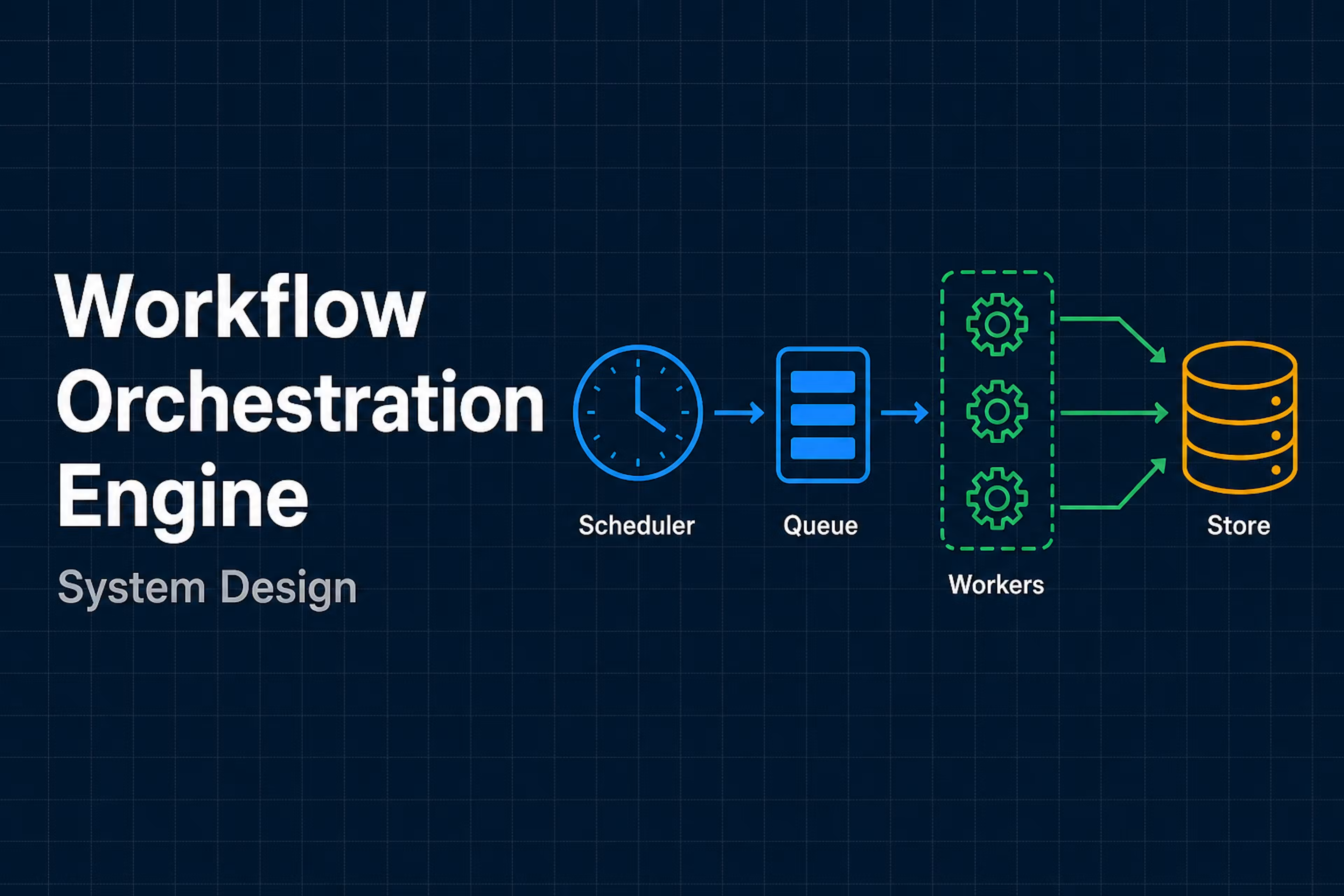
An autonomous workflow typically begins when a system receives an instruction, event or piece of information. The AI analyses the input, identifies the objective and determines which actions may be required. It can then break a larger request into smaller steps, prioritise those steps and interact with connected applications. This allows complex workflows to progress without requiring employees to manually direct every stage.
Context is another important part of the process. An intelligent system may use previous conversations, company information, databases or predefined policies to determine the most appropriate response. Monitoring mechanisms can also track completed actions and identify failures. When an action falls outside defined boundaries, the workflow can request human approval rather than proceeding without supervision.
Key Technologies Behind Intelligent Workflows

AI agents are an important technology behind autonomous workflows because they can interpret goals and determine how to accomplish them. Large language models can help these agents understand natural language, summarise information and generate responses. Machine learning can support pattern recognition, while natural language processing enables systems to work with emails, documents, conversations and other human-generated content.
Software integrations also make intelligent workflows considerably more useful. APIs can connect AI systems with customer relationship management platforms, databases, communication tools, accounting software and other business applications. Instead of operating in isolation, an AI system can move information between connected platforms and trigger actions. These integrations create a digital environment where different applications can work together through a coordinated workflow.
Benefits of Autonomous Task Handling for Businesses
One of the biggest advantages of autonomous task handling is its ability to reduce repetitive workloads. Employees frequently spend hours sorting emails, entering information, checking records, preparing routine reports or responding to common questions. Intelligent systems can manage many of these activities automatically, allowing employees to dedicate more attention to strategic planning, customer relationships and creative problem-solving.
Businesses can also benefit from improved consistency and scalability. Automated systems can perform defined tasks continuously without becoming tired or distracted, while organisations can increase processing capacity as demand grows. Faster responses can improve customer satisfaction, and streamlined operations may reduce unnecessary costs. However, the greatest value often comes from combining machine efficiency with human expertise rather than treating automation as a complete replacement for people.
Autonomous Task Handling Use Cases
Customer service is a strong example of where intelligent workflows can create practical value. AI systems can classify enquiries, identify frequently requested information and provide suitable responses. They can also route complicated cases to the correct employee. In sales, similar technology can qualify leads, update customer records and trigger follow-up activities, reducing the administrative workload placed on sales teams.
Other applications include document processing, finance administration, human resources, marketing and IT support. An organisation might use AI to extract information from documents, schedule meetings, monitor technical systems or assist with employee onboarding. E-commerce businesses can also automate order enquiries and routine customer communications. These examples demonstrate how flexible AI-powered workflows can support different departments and industries.
Autonomous Task Handling vs Traditional Automation
Traditional automation usually depends on predefined instructions such as “if this happens, perform that action”. This approach remains highly effective for predictable and repetitive processes. However, it can become difficult to maintain when workflows involve unexpected information, changing circumstances or language-based requests. Autonomous systems are designed to provide greater flexibility by interpreting context rather than relying exclusively on rigid rules.
The difference becomes clear when handling customer communication. A traditional workflow might automatically send a fixed response whenever a particular keyword appears. An AI-powered system can interpret the meaning of a message, consider available information and generate a more relevant response. Nevertheless, conventional automation can still be preferable for simple, predictable tasks where transparency and strict consistency are more important than flexibility.
Challenges and Risks of AI-Driven Automation
Although autonomous task handling can improve efficiency, it also introduces risks that businesses must understand. AI systems may misunderstand instructions, produce inaccurate information or take an inappropriate action when the available context is incomplete. These risks become more significant when systems have access to sensitive data or the authority to make important operational decisions.
Security, privacy and accountability are equally important considerations. Organisations should carefully control which systems an AI agent can access and which actions it is allowed to perform. Human approval should remain available for high-risk decisions. Regular testing, monitoring and auditing can help identify problems early. A successful strategy therefore balances automation with clear governance, technical safeguards and responsible oversight.
How to Implement Autonomous Task Handling Successfully
The most effective approach is usually to begin with processes that are repetitive, measurable and relatively low risk. Businesses should identify where employees spend significant amounts of time on routine activities and determine whether AI can complete those tasks reliably. Clear objectives should then be established so that performance can be measured against factors such as time saved, accuracy and customer satisfaction.
After selecting an appropriate workflow, organisations can introduce the technology gradually. Integrations should be tested carefully, access permissions should be limited and human approval points should be established where necessary. Businesses should also monitor performance after deployment rather than assuming the system will work perfectly from the beginning. Continuous testing and refinement can improve reliability while reducing operational risks.
Best Practices for Autonomous AI Workflows
A well-designed autonomous workflow needs clear instructions and boundaries. AI systems should understand what they are responsible for, which information they may access and which actions require approval. Reliable data sources should be prioritised, while sensitive information should be protected through appropriate security controls. Businesses should also create fallback procedures for situations where the system cannot confidently complete a task.
Regular performance reviews are essential for long-term success. Teams can monitor completion rates, errors, processing times and instances where human intervention was required. Feedback from employees can reveal practical problems that technical measurements may overlook. By combining performance data with human feedback, organisations can gradually improve their workflows and ensure that AI remains aligned with real business requirements.
The Future of Autonomous Task Handling
The future of autonomous task handling is likely to involve increasingly capable AI agents that can coordinate multiple steps across different applications. Instead of simply responding to individual commands, these systems may manage complete processes from beginning to end. For example, an AI agent could receive a business objective, gather information, create a plan, communicate with relevant systems and report the outcome.
As these capabilities develop, human roles are likely to evolve rather than disappear entirely. Employees may spend less time performing repetitive administrative work and more time supervising intelligent systems, making strategic decisions and solving complex problems. Responsible AI governance will become increasingly important as organisations give automated systems greater access to information, software and business processes.
Conclusion
Autonomous task handling is changing the way organisations approach everyday work by allowing AI systems to understand instructions, process information and complete defined activities with greater independence. Its value extends beyond simply saving time. When implemented carefully, intelligent automation can improve workflow efficiency, scalability, consistency and employee productivity while helping businesses respond more quickly to changing demands.
The strongest results come from a balanced approach that combines intelligent technology with human oversight. Businesses should begin with suitable processes, establish clear boundaries and continuously monitor performance. As AI agents and connected software become more advanced, organisations that adopt responsible and practical automation strategies can build workflows that are faster, more adaptable and better prepared for the future.
Frequently Asked Questions About Autonomous Task Handling
What is autonomous task handling?
Autonomous task handling uses artificial intelligence to understand objectives and complete defined tasks with limited human intervention. It can interpret information, plan actions and interact with connected software. Unlike basic automation, it can potentially respond to changing information and different situations, making it suitable for workflows that involve language, context and multiple steps.
How does autonomous task handling differ from traditional automation?
Traditional automation generally follows predefined rules and fixed sequences, while AI-driven workflows can interpret information and make context-based decisions. Traditional automation remains useful for predictable processes, whereas intelligent systems are better suited to workflows where information changes or requires interpretation. Many organisations can benefit from combining both approaches rather than choosing only one.
What are the main benefits of autonomous task handling?
The main benefits include reducing repetitive workloads, improving operational efficiency and helping employees focus on higher-value responsibilities. Organisations may also achieve faster response times, greater consistency and improved scalability. The overall impact depends on the quality of the AI system, available data, workflow design and level of human oversight.
Can autonomous task handling replace human employees?
AI can automate certain tasks traditionally performed by employees, but that does not necessarily mean it can replace entire roles. Human judgement, creativity, communication and strategic decision-making remain valuable. In many workplaces, the more practical approach is to use AI to handle repetitive activities while employees supervise systems and concentrate on responsibilities requiring human expertise.
Is autonomous task handling secure?
Security depends on how the technology is designed and deployed. Businesses should restrict system permissions, protect sensitive information, monitor automated actions and establish approval requirements for high-risk activities. Regular testing and auditing are also important. Organisations should ensure that AI systems follow appropriate security, privacy and governance policies before giving them access to critical business processes.
How can a business implement autonomous task handling?
A business can begin by identifying repetitive, measurable and low-risk workflows that could benefit from AI. After selecting a suitable technology, the organisation should establish clear objectives, permissions and human approval points. Testing should take place before full deployment, followed by continuous monitoring and improvement to ensure that the system remains accurate, reliable and aligned with business goals.