Introduction to Responsible AI Frameworks
Artificial intelligence is transforming how organisations operate, make decisions, communicate with customers, and develop products. As AI becomes more capable, businesses must also consider privacy, fairness, security, transparency, and accountability. Responsible AI frameworks provide a structured way to address these concerns, helping organisations adopt AI while maintaining appropriate safeguards for people, data, and business operations.
Responsible AI is not about preventing organisations from experimenting with new technology. Instead, it creates practical boundaries that encourage innovation while reducing avoidable risks. A strong framework can guide teams from the earliest stages of AI development through deployment and ongoing monitoring, ensuring that ethical considerations remain connected to technical performance and business objectives.
What Are Responsible AI Frameworks?
Responsible AI frameworks are structured sets of principles, policies, processes, controls, and responsibilities designed to guide the safe and ethical development and use of artificial intelligence. They help organisations determine how AI systems should be created, evaluated, deployed, monitored, and improved throughout their lifecycle.
A framework can include governance structures, risk assessments, data management practices, fairness testing, security controls, documentation, human oversight, and compliance procedures. While organisations may use different approaches, the underlying objective remains similar: making AI more trustworthy, accountable, transparent, and aligned with responsible business practices.
Why Responsible AI Frameworks Matter
AI systems can create significant value, but poorly managed technology can introduce serious risks. Biased models may produce unfair outcomes, inaccurate systems can influence poor decisions, and insecure applications may expose confidential information. Organisations also face concerns involving intellectual property, privacy, misinformation, regulatory requirements, and the inappropriate use of automated decision-making.
Responsible AI frameworks help businesses manage these challenges systematically. They can strengthen customer confidence, improve internal accountability, and support more consistent AI decision-making. When employees understand how AI should be used and monitored, organisations can pursue innovation with greater confidence instead of reacting to problems only after they have caused damage.
Core Principles of Responsible AI
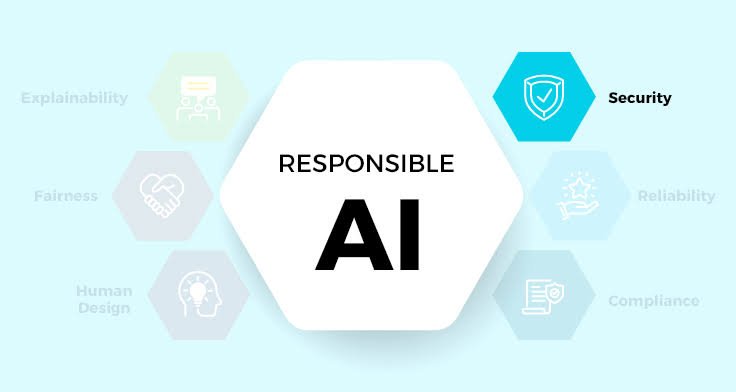
Responsible AI is built around several principles that help organisations evaluate whether their systems are appropriate for real-world use. Fairness focuses on reducing unjustified discrimination, while transparency helps stakeholders understand how AI is being developed and used. Accountability ensures that people and organisations remain responsible for important outcomes rather than shifting responsibility entirely to algorithms.
Privacy, security, safety, reliability, explainability, inclusiveness, and human oversight are also important. These principles may have different priorities depending on the application. An AI tool used for simple productivity tasks may require different safeguards from a system involved in financial decisions or employment. Effective governance therefore considers both the technology and its potential impact.
Key Components of Responsible AI Frameworks
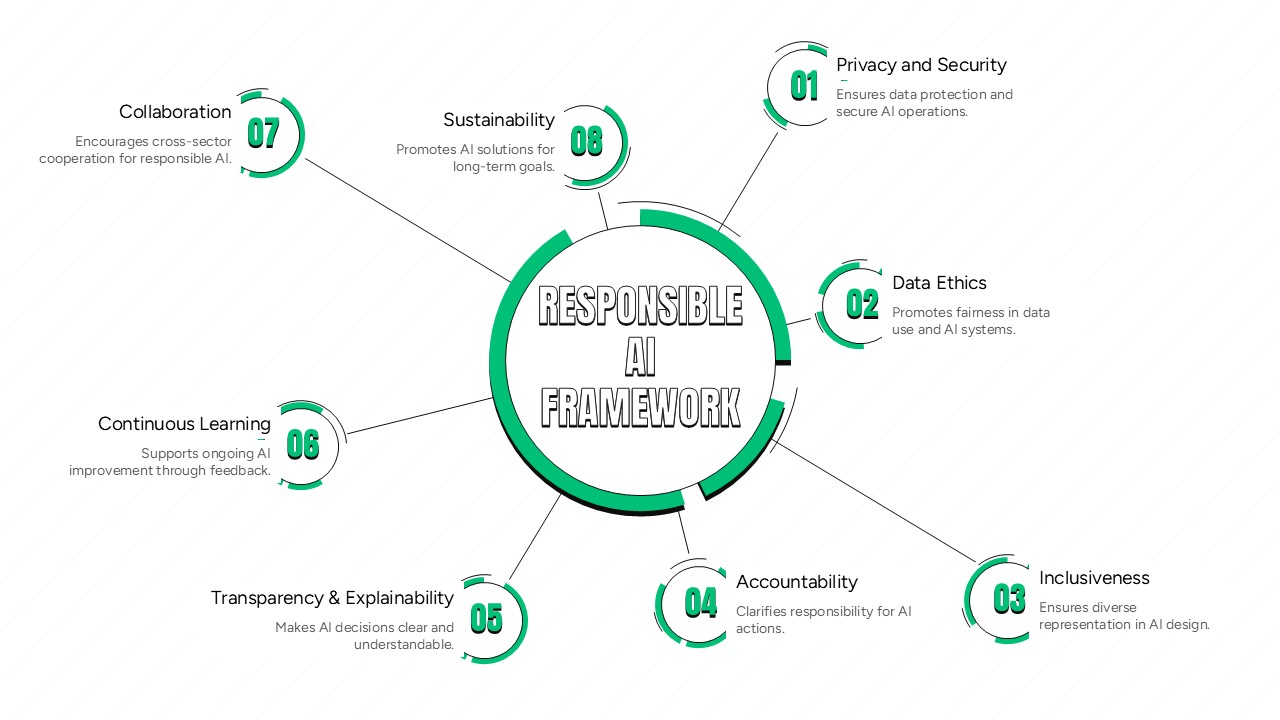
A comprehensive framework normally begins with clear governance and leadership responsibilities. Organisations need to know who can approve AI systems, who manages risks, and who responds when something goes wrong. AI policies should establish acceptable uses, prohibited activities, data requirements, security expectations, and procedures for reviewing higher-risk applications.
Risk assessment, data governance, fairness testing, documentation, and monitoring provide additional layers of control. Organisations should maintain an inventory of AI systems and understand what each system does, what information it uses, and how important its outputs are. This visibility makes it easier to apply proportionate controls and maintain accountability across the organisation.
Building a Responsible AI Framework
Building a framework starts with understanding how an organisation currently uses AI. Teams can identify existing applications, assess their risks, review current policies, and determine where governance gaps exist. Leadership should then establish clear objectives and involve representatives from technology, legal, compliance, security, data, risk, and relevant business functions.
Once responsibilities are established, organisations can create policies, risk classifications, approval processes, testing requirements, and monitoring procedures. Employee training is equally important because even the strongest policy has limited value if people do not understand it. A practical framework should be scalable, easy to apply, and flexible enough to evolve with changing technology.
Responsible AI Risk Management
AI risk management involves identifying potential problems before they become serious incidents. Risks can include technical failures, biased outcomes, privacy violations, cybersecurity threats, unreliable predictions, regulatory issues, reputational damage, and operational disruption. Organisations should assess these risks according to the purpose of each AI system and the potential impact on affected people.
Higher-risk applications generally require stronger controls. These may include additional testing, independent reviews, human approval, detailed documentation, restricted access, and continuous monitoring. Risk management should not end when an AI model goes live. Systems can behave differently as data and circumstances change, making ongoing assessment an essential part of responsible AI management.
Responsible AI and Data Governance
Data is one of the foundations of responsible artificial intelligence. Poor-quality, incomplete, outdated, or unrepresentative data can reduce model performance and contribute to unfair outcomes. Organisations should understand where data comes from, how it is processed, who can access it, and how long it should be retained.
Strong data governance also supports privacy and accountability. Businesses should establish appropriate controls for personal and confidential information and document important data flows. Training data, retrieval sources, and other information used by AI applications should be reviewed carefully. Better data governance can improve reliability while reducing the possibility that hidden data problems undermine an otherwise sophisticated AI system.
Responsible AI and Algorithmic Fairness
Fairness is a central part of responsible AI because algorithms can reproduce or amplify patterns found in historical data. An AI system may produce different outcomes for groups even when sensitive characteristics are not directly included. Organisations therefore need to examine data representation, model behaviour, performance differences, and real-world outcomes.
Fairness testing should occur throughout the AI lifecycle rather than being treated as a final checkpoint. Businesses can select suitable fairness metrics, investigate disparities, improve data, adjust models, and introduce human oversight where appropriate. The goal is not always to make every outcome identical, but to identify and reduce unjustified differences that could create harmful or discriminatory effects.
Responsible AI for Generative AI and AI Agents
Generative AI has created new governance challenges because systems can produce convincing text, images, audio, video, and code. These outputs may contain inaccurate information, biased representations, confidential details, or copyrighted material. Organisations therefore need clear policies covering approved tools, acceptable use, sensitive information, content verification, and human review.
AI agents create another layer of complexity because they can potentially perform multiple actions, interact with applications, and operate with greater autonomy. Organisations may need permission controls, activity monitoring, escalation procedures, and human intervention mechanisms. As AI becomes more autonomous, governance must focus not only on individual outputs but also on the actions and consequences produced by AI-driven workflows.
Transparency, Explainability, and Accountability
Transparency allows organisations to document what an AI system is designed to do, what information it uses, and what limitations it has. Documentation can include information about datasets, model objectives, testing results, intended uses, known risks, and responsible teams. This information makes AI systems easier to review and manage.
Explainability focuses on helping users understand why a system produced a particular recommendation or result. However, an understandable explanation does not automatically mean that a system is fair or reliable. Accountability remains essential because organisations must determine who is responsible for decisions, monitoring, corrections, and responses when AI systems produce unexpected or harmful results.
AI Security, Privacy, and Safety
Security should be integrated into AI governance from the beginning. AI applications can face threats involving unauthorised access, malicious inputs, data leakage, manipulation, and misuse. Organisations should evaluate these risks during development and deployment while applying suitable access controls, testing procedures, monitoring, and incident-response plans.
Privacy is equally important, particularly when AI systems process personal or confidential information. Businesses should understand what information enters their AI applications and where that information may be stored or processed. Safety and reliability testing can further help organisations identify unexpected behaviour before it affects customers, employees, or other stakeholders.
Responsible AI Compliance and Regulation
AI regulation is developing across jurisdictions, making compliance an important consideration for organisations operating AI systems. Legal requirements may involve privacy, consumer protection, employment, intellectual property, cybersecurity, transparency, and risk management. Organisations should therefore monitor applicable rules and understand how they affect specific AI use cases.
Compliance should be integrated into broader governance rather than treated as a separate administrative task. Maintaining documentation, risk assessments, audit records, approval procedures, and monitoring evidence can help demonstrate that an organisation takes responsible AI seriously. Regular reviews are important because both regulations and AI capabilities can change rapidly.
Implementing Responsible AI Frameworks in Organisations
Implementation works best when organisations take a practical, phased approach. Businesses can begin by identifying AI applications and categorising them according to risk. Leadership can then assign responsibilities, establish policies, introduce approval processes, and create requirements for testing and documentation. This provides a foundation that can expand as AI adoption increases.
Training should accompany every stage of implementation. Employees need to understand AI limitations, privacy considerations, security risks, approved tools, and internal responsibilities. Organisations should also establish monitoring and reporting mechanisms. Regular assessments can reveal whether policies are working effectively and where additional controls or training may be required.
Measuring the Success of Responsible AI
A responsible AI programme should be measurable. Organisations can track AI incidents, fairness indicators, model performance, privacy events, security findings, compliance issues, and audit results. These metrics can reveal whether governance controls are reducing risks or whether certain areas require additional attention.
Employee participation in AI training and adoption of approved tools can also provide useful indicators. Organisations may consider stakeholder trust, transparency, and user feedback when evaluating broader outcomes. Measurement should ultimately help leadership balance responsible risk management with business value, ensuring that governance supports innovation rather than becoming an isolated administrative exercise.
Common Challenges When Adopting Responsible AI Frameworks
One major challenge is the speed at which AI technology evolves. Policies created for one generation of systems may become less suitable as new models, agents, and applications emerge. Organisations may also struggle with limited internal expertise, unclear ownership, competing business priorities, and difficulties in measuring concepts such as fairness and explainability.
Third-party AI services and shadow AI create additional challenges. Employees may use external tools without understanding how information is processed or stored. Organisations can address these issues through clear policies, approved tool lists, employee education, vendor assessments, and practical governance processes. The goal should be to make responsible behaviour easier, not simply to impose restrictions.
Best Practices for Responsible AI Adoption
Organisations should begin with clear leadership accountability and realistic objectives. Instead of applying the same controls to every AI application, businesses can use a risk-based approach. Systems with greater potential impact should receive stronger assessment, testing, human oversight, and monitoring, while lower-risk applications can follow proportionate controls.
Responsible AI should also be integrated with existing risk, compliance, cybersecurity, and data governance programmes. Maintaining an accurate AI inventory, conducting regular reviews, training employees, documenting important decisions, and creating clear incident procedures can strengthen accountability. Continuous improvement is essential because responsible AI is not a static policy; it is an evolving organisational capability.
The Future of Responsible AI Frameworks
The future of responsible AI will be shaped by increasingly capable models, autonomous AI agents, evolving regulations, and more sophisticated governance technologies. Organisations may rely more on continuous monitoring, automated risk detection, AI assurance, independent assessments, and real-time controls to manage complex AI environments.
As AI becomes embedded in more business processes, responsible practices could become a competitive advantage rather than simply a compliance requirement. Organisations that demonstrate trustworthy AI practices may build stronger relationships with customers, employees, regulators, and partners. Flexible frameworks will be particularly valuable because they can evolve alongside technology without requiring businesses to rebuild their governance structures from scratch.
Conclusion: Building a Responsible AI Future
Responsible AI frameworks give organisations a practical foundation for developing and using artificial intelligence in a safer, more ethical, and accountable way. They bring together fairness, transparency, privacy, security, human oversight, risk management, and compliance while allowing businesses to continue exploring new opportunities created by AI.
The strongest approach is continuous rather than static. Organisations should regularly assess their systems, train employees, monitor outcomes, update policies, and respond to emerging risks. By treating responsible AI as an ongoing business capability, organisations can build greater trust and create an environment where innovation and ethical responsibility develop together.
Frequently Asked Questions About Responsible AI Frameworks
What are responsible AI frameworks?
Responsible AI frameworks are structured approaches that help organisations develop, deploy, and manage artificial intelligence responsibly. They typically include principles, policies, risk assessments, governance roles, testing procedures, monitoring controls, and accountability requirements.
Why are responsible AI frameworks important?
They help organisations identify and manage risks involving bias, privacy, security, accuracy, transparency, and compliance. A strong framework can also improve stakeholder trust and provide a safer foundation for responsible AI adoption.
What are the main principles of responsible AI?
Common principles include fairness, transparency, accountability, privacy, security, safety, reliability, explainability, inclusiveness, and human oversight. Organisations can prioritise these principles according to the purpose and risk level of individual AI applications.
What should a responsible AI framework include?
A framework can include governance responsibilities, AI policies, risk assessments, data governance, fairness testing, security controls, documentation, human oversight, monitoring, incident management, employee training, and periodic reviews.
How can a business implement a responsible AI framework?
Businesses can begin by identifying their AI systems, assessing risks, assigning ownership, creating policies, introducing testing and approval processes, training employees, and implementing continuous monitoring. The framework should then be reviewed and improved as AI adoption grows.
How do responsible AI frameworks address algorithmic bias?
They can require organisations to evaluate data representation, test AI outcomes across relevant groups, use appropriate fairness metrics, document findings, and introduce mitigation strategies. Continuous monitoring can help identify new disparities after deployment.
Are responsible AI frameworks relevant to generative AI?
Yes. Generative AI requires controls for accuracy, privacy, confidential information, copyright, bias, security, and human review. Organisations should also establish clear rules governing which generative AI tools employees can use and for what purposes.
Who is responsible for responsible AI?
Responsibility is shared across leadership, technology teams, data professionals, legal and compliance departments, cybersecurity teams, risk specialists, and AI users. Clear ownership is essential so that important governance tasks are not overlooked.
How can organisations measure responsible AI success?
Organisations can monitor AI incidents, fairness outcomes, model performance, security events, privacy issues, compliance findings, training completion, audit results, and stakeholder feedback. These measures can help identify weaknesses and guide continuous improvement.
What are the biggest challenges of responsible AI frameworks?
Common challenges include rapidly changing technology, evolving regulations, limited expertise, data-quality problems, unclear accountability, third-party AI risks, shadow AI, and difficulties in measuring ethical concepts. Flexible governance and ongoing education can help organisations address these challenges.
How will responsible AI frameworks evolve in the future?
Frameworks are likely to incorporate stronger AI assurance, continuous monitoring, automated governance tools, autonomous-agent controls, independent assessments, and evolving regulatory requirements. Organisations will increasingly need frameworks that can adapt quickly as AI capabilities develop.